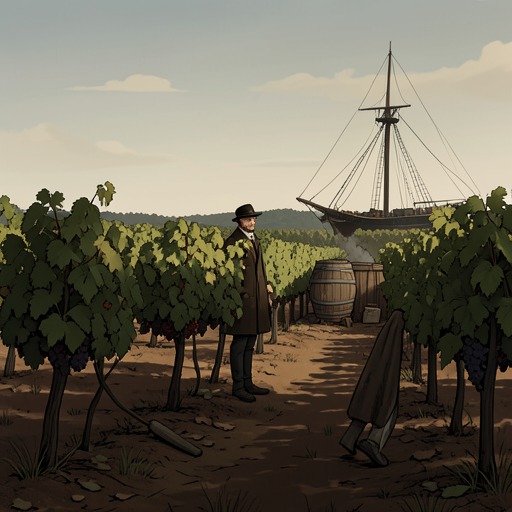
Vincenzo establishes a Marsala wine cellar with Raffaele
The Florios of SicilyVincenzo establishes a Marsala wine cellar with Raffaele as a deliberate industrial venture, not simply a place to store wine. Its location is chosen to bypass inadequate roads and bring barrels straight to ships; its architecture is modeled on British factories; and its operations are planned around local grape must, sherry casks, and skilled coopers. The cellar’s construction culminates in Vincenzo offering Raffaele a formal share in the enterprise, binding commercial design to family and partnership.
Purpose and location
The project begins with Vincenzo and Raffaele examining a map of the Marsala coast laid over a map of the sulfur quarry. Vincenzo is drawn to a site with direct sea access. The roads nearby are little more than sheep tracks, and large wagons cannot use them; building around road transport would mean spending on carts and carritteddi. Vincenzo instead wants barrels to travel from the plants directly into ships’ holds. The sea is therefore not a picturesque backdrop to the cellar but the infrastructure that makes its location commercially useful.
The proposed land lies in Contrada Inferno, behind a natural hill. Raffaele reports that two tummini are for sale at sixty oncie, with an additional tax payable to Baron Spanò. Vincenzo presses to secure the property at once, authorizing an advance if needed. Interest in marsala wine is rising, he argues, and the land’s price will soon climb. His decision joins immediate logistics to speculation: access to shipping lowers the need for overland transport, while the expected increase in value makes delay costly.
A factory in the landscape
When Vincenzo later visits the site, the tramontana sweeps along the coast and the Aegadian Islands appear across the water like iron masses against the sky. Workers are raising walls on scaffolding that shudders in the gusts. Against this exposed setting, Vincenzo has a precise model in mind: not a country house with an inner courtyard, nor one of the farms scattered through Sicily, but a factory like those in Britain, with a large central courtyard and warehouses arranged around it. The project’s form signals a shift from estate-like building toward an organized production and storage complex.
Inside one of the two side buildings, carpenters are setting supports for the wine-refinement casks. Light enters through portals and dormer windows beneath a high ceiling punctuated by tuff arches; the air carries the sea and salt. Vincenzo identifies this hall as the heart of the cellar. Its scale and construction give material shape to the operating plan: wine is to be refined and handled within a purpose-built complex close to the coast, rather than treated as an incidental commodity housed wherever space happens to be available.
Supply, processing, and labor
Raffaele reports that grape procurement has gone better than expected. Woodhouse and Ingham have already secured much of the harvest, but he has found ansonica, grillo, and damaschino must in Alcamo, as well as a load of catarratto. Wine that has already fermented is due to be transferred to the new cellar the following week. These arrangements connect the site to several parts of the regional harvest and distinguish its work from the established British firms’ influence over local supply.
The operating plans extend beyond grapes. Casks of sherry for refinement are also expected the following week, and Vincenzo has prepared a memorandum naming Palermo coopers, one of whom is willing to move his workshop to the site. The cellar thus depends on more than land and stored wine: it requires incoming casks, skilled cooperage, procurement, and the movement of fermented product. Vincenzo treats these links as parts of one system, and Raffaele’s reports show that much of the practical groundwork is already underway.
Partnership and commercial stakes
The purchase appears at first as an investment organized between the cousins: Raffaele brings Vincenzo the map and later reports on land, harvest, and preparations. But at the cellar, Vincenzo makes clear that he does not want someone merely to look after the business without sharing its risks. Raffaele has already put money aside to buy the land, and Vincenzo proposes converting that commitment into an ongoing partnership among Raffaele Barbaro, Ignazio Florio, and Vincenzo. The offered division is one third for Raffaele and two thirds for Casa Florio.
Raffaele is so surprised that he freezes. Vincenzo stops and turns back to explain the distinction: he wants Raffaele involved with the business’s money, not simply performing its management. The exchange makes the cellar’s physical construction inseparable from its financial structure. A project organized around efficient routes, dedicated buildings, supplies, and skilled labor is also designed to distribute ownership and responsibility. The venture’s significance lies in that combination: Vincenzo builds for production at scale and invites a trusted cousin into the capital and continuing stakes of the enterprise.